911 Memorial - New Jersey
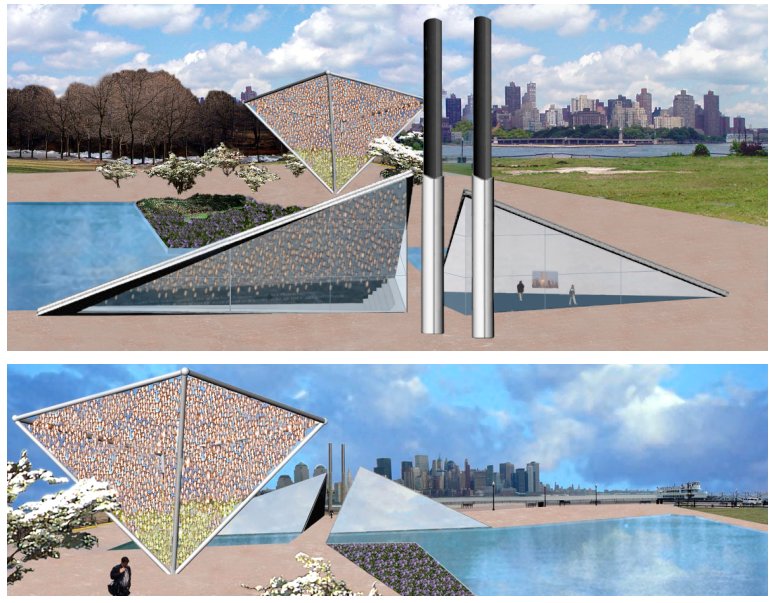
Copyright © 2004 RON ROCCO All Rights Reserved
911 Memorial - New Jersey
Copyright © 2004 RON ROCCO All Rights Reserved
911 Memorial - New Jersey
In undertaking to symbolically representation each New Jersey resident who lost his or her life as a result of the events of September 11, 2001 it seemed important to place this loss in context with the enormity of what came to pass on that fateful day. Therefore this proposal seeks to represent these individuals along with the other 2298 co-workers, friends and fellow citizens whose lives were lost in this tragic event.
My effort to provide New Jersey with a September 11th memorial significant in impact and welcoming for all individuals led me to reflect upon one of humanity's most enduring symbols of remembrance. For this reason I have chosen a Pyramid as the central element of this memorial.
The Pyramid is a symbol of spiritual endurance and an ancient object of veneration for the dead. This powerful symbol is employed here to mark the sacredness of the lives lost and the enduring commitment of those that survived, to the memory of this event and to the memory of those that were lost to it. The inversion of the Pyramid is meant to evoke the magnitude of personal and physical loss, which occurred and the historical significance of the event. The inverted Pyramid, which expands upward to the sky embraces the heavens, providing a release to the spirit and a suggestion of rebirth.
My plan for this site includes the entire area outlined in the RFP and establishes a central memorial plaza, lined to the west by trees and to the south by plantings. The Pyramid rises from this plaza. Beyond the plaza a water channel bisects the center of the site, from the north west corner to the south east, bridged by a walkway which leads to a Memorial Chapel and Interpretive Center on the eastern half of the site. These structures provide the visitor with interior spaces for remembrance and contemplation of the events marked by this memorial.
The identity of this site, specifically as a memorial for the State of New Jersey, is reinforced by way of the western grove of flowering dogwood trees, the state memorial tree (authorized by Assembly Concurrent Resolution) and nearby plantings of Violets (Viola sororia) the State flower. The dogwood grove positioned along the western half of the site will be landscaped to reference the Memorial Tree Grove at the beginning of Audrey Zapp Drive, which includes 20 flowering dogwoods as well. This landscaping may encompass the use of Belgian block pavers at the foot of each tree, or other landscape elements. Seating accommodations such as stone or wood benches would be located in this area. The violet plantings will frame the northern edge of a large reflecting pool, and line the most direct passageway to the Memorial Chapel and Interpretive Center. The surface of the memorial site walkways and plaza will consist of pink granite paving stones.
The Pyramid of Loss will dominate the memorial site, providing a navigational reference from both Manhattan and the Memorial Tree Grove at the entrance of Liberty State Park. The Pyramid will also be an outside area of reflection and contemplation. It will be of stainless steel construction; its inverted base measuring 50 feet on each side and it will rise above the Memorial Plaza 50 feet from the memorial plaza paving. Within the Pyramid will be 2998* cast and anodized aluminum tablets suspended from stainless steel cables. Each tablet will be imprinted with the image of a single raised hand. There will be 700* gold colored plates representing specifically those victims who were New Jersey residents. These tablets will be clustered closest to the inverted tip of the Pyramid, nearest to ground level. There will be additional 2298 bronze-colored plates, representing the other persons who died in Pennsylvania, Virginia and at the World Trade Center Site. The light reflected from this structure, which rises above the western tree cover and southern reflecting pool, and the colored elements contained within it beckon to visitors entering the site, attracting their interest and welcoming them.
Walking east from the Pyramid the visitor crosses a bridge walkway, which bisects the two structures containing the Memorial Chapel and the Interpretative Center. From this direction the buildings, both of triangular format, rise up at a gentle 30° slope on both sides of the visitor, surrounding them with the sound of the twin cascades of water which stream down the two roof surfaces. Stone aggregates may be used on the roofs of both the Memorial Chapel and the Interpretative Center to accentuate the waters turbulence. The walkway faces the New York City skyline and is aligned directly toward the former position of the World Trade Towers on the opposite shore. At it's far end stand two columns, which are positioned to mark the vertical lines of the World Trade Towers on the skyline. Atop these columns are the two steel beams from the World Trade Tower buildings currently in storage.
To the left, north of the walkway is the Interpretative Center, which is enclosed in a clear glass skin on it's eastern face. It has a bright, spare interior designed for the installation of media presentations, exhibitions and personal histories pertaining to the events of September 11, 2001. Due to the need of preserving site lines for the Landing Marina Restaurant's views, the configuration of this structure is a right triangular format, with hypotenuse beginning at the north west corner of the site running to the south east toward the WTC Column, north of the walkway. This has reduced the perceptual impact of the structure to a tapered penetration of the skyline at its southern most point.
To the right, south of the walkway is the Memorial Chapel, a meditative center enclosed in a smoked glass skin on it's northern and eastern faces. The chapel will be a place for the public to make personal tributes of notes, flowers and memorabilia, which could be accommodated along the glass walls of the upper floor level. The interior of this structure is darkened to bring recognition of each of the New Jersey victims by use of 700 suspended votive lamps, which cover the ceiling of the chapel. The interior floor of this building is stepped down in seven shallow steps to a subterranean surface 3 or 4 feet below the memorial plaza (this may depend on site requirements). The floor in this area will contain several glass-covered enclosures containing artifacts taken from each of the sites of the attacks. The eastern and western walls of this lower area are surfaced with black marble. The eastern wall surface will be inscribed with the name, community of residence and age at time of death, of each of the 700 recognized New Jersey victims. I would suggest that the names not be presented in a simple alphabetical sort, but that they be sorted first by community of residence. This will preserve their identity as community members, listing neighbor with neighbor, and give the visitor a sense of the great loss inflicted on some New Jersey communities. The western surface may be inscribed with the following text:
THIS MEMORIAL STANDS IN MEMORY OF THE 700 RESIDENTS OF THIS STATE WHO LOST THEIR LIVES ALONG WITH 2298 CO-WORKERS, FRIENDS AND FELLOW CITIZENS IN PENNSYLVANIA, VIRGINIA AND LESS THAN A MILE FROM THIS SITE, AT THE WORLD TRADE CENTER BUILDINGS DURING THE EVENTS OF SEPTEMBER 11, 2001.
THEY WERE NOT SOLDIERS OF ANY NATION. THESE WERE THE CITIZENS OF NINTY TWO NATIONS OF THE WORLD, CAUGHT IN A MOMENT BROUGHT UPON THEM BY BLIND HATRED. THEIR SACRIFICE SHALL UNITE ALL PEACE LOVING NATIONS TO REMOVE THE SEEDS OF HATE FROM OUR MIDST, JUST AS THEY ARE UNITED FOR ALL ETERNITY.
As one exits the chapel structure and turns to the right, a passageway runs south, and the visitor passes along the eastern edge of a 16,200 sq. ft. reflecting pool, which covers the entire southern edge of the memorial area. This returns the visitor to the CRRNJ building and ferry docks.